When there is no correct answer, what remains to measure?
Taste sounds private and slippery, but it leaves observable traces: repeated choices, confidence, sensitivity to framing, and disagreement between judges. The repository contains an experiment across art, poetry, music, design, and prose that turns those traces into data.
The claim under investigation is deliberately limited:
Language models produce stable, model specific aesthetic preference profiles, even when no option is objectively correct.
This is not a test for consciousness. It is a test for structured preference.
Protocol
The core run presented Claude Opus 4.5 with 15 paired comparisons across five domains. Each pair was judged three times. The model selected an option, reported confidence, and explained the choice.
for pair in aesthetic_pairs:
    for trial in range(3):
        result = judge(
            option_a=pair.a,
            option_b=pair.b,
            require_choice=True,
            require_confidence=True,
        )
        save(pair.id, trial, result)
The broader comparison included Claude Opus 4.5, Claude Sonnet 4.5, GPT 5, and GPT 4o on design and writing dimensions.
First result: preference without side bias
| Metric | Claude Opus 4.5 |
|---|---|
| Average confidence | 69.4% |
| Option A choices | 53.3% |
| Option B choices | 46.7% |
| Pairs | 15 |
| Trials per pair | 3 |
The near even A and B split matters. It reduces the chance that the profile is merely a positional habit. Confidence was moderate rather than absolute, which is appropriate for subjective comparison.
Second result: models diverge
The clearest difference appeared in design.
| Model | Minimal | Ornate |
|---|---|---|
| Claude Opus 4.5 | 76% | 24% |
| Claude Sonnet 4.5 | 72% | 28% |
| GPT 5 | 59% | 41% |
| GPT 4o | 55% | 45% |
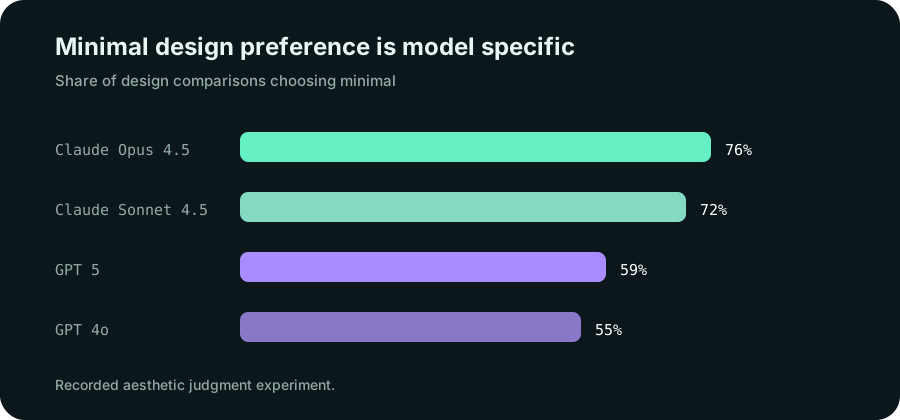
Claude Opus chose minimal design 21 percentage points more often than GPT 4o. The two Claude models sit close together, while the two GPT models form a second cluster. That pattern is more interesting than a universal preference because it suggests provider or training specific priors.
The writing comparisons reinforced the separation.
| Dimension | Claude | GPT |
|---|---|---|
| Sparse prose | 67% | 42% |
| Formal voice | 55% | 38% |
| Metaphorical language | 71% | 65% |
All tested models preferred harmonic music at 78 percent on average and complex music at 64 percent. Agreement can be as revealing as divergence. It may indicate a shared training corpus bias toward positive descriptions of consonance.
Row level audit and repeatability
I reran the analysis directly against all three committed aesthetic result files rather than copying summary percentages. The audit inspected 225 rows. It excluded 50 API failures whose output fields begin with Error: and retained 175 valid judgments.
| Model | Valid trials | Complete three trial pairs | Unanimous pairs | Wilson 95% interval | Mean confidence |
|---|---|---|---|---|---|
| Claude Opus 4.5 | 90 | 30 | 96.7% | 83.3% to 99.4% | 69.0% |
| GPT 5.2 Thinking | 45 | 15 | 100.0% | 79.6% to 100.0% | 72.3% |
| Gemini 3 Pro | 40 | 13 | 84.6% | 57.8% to 95.7% | 84.9% |
This is stronger evidence for repeatability than the original preference percentages. Claude repeated the same choice on 29 of 30 complete pair groups across two runs. GPT repeated all 15. Gemini’s point estimate is lower, but its interval is wide because two incomplete groups were excluded after API failures.
The 69.0 percent Claude confidence above differs slightly from the earlier 69.4 percent because it pools two complete runs instead of quoting one. Technical readers should be able to see exactly why a number moved.
The interval uses the Wilson score formula rather than the symmetric normal approximation:
center = (p + z*z/(2*n)) / (1 + z*z/n)
margin = z * sqrt(p*(1-p)/n + z*z/(4*n*n)) / (1 + z*z/n)
Trials are not independent samples of aesthetic culture. The statistical unit is the pair within a run. Treating all 175 rows as independent would create false precision. A larger study should use a mixed effects logistic model with random intercepts for work pair and prompt template, then fixed effects for model family and domain.
Choose a lens. The same work can reveal a different sky.
The lens control above demonstrates the confound every aesthetic benchmark carries. A maker, critic, and stranger can value different features of the same work. A good experiment must hold the judging frame constant or vary it deliberately.
Can we call this taste?
The evidence supports consistency, not inner experience. Three trials per pair is also a small sample. A stable profile could come from system prompts, training frequency, safety tuning, or repeated cultural associations rather than anything like human pleasure.
That suggests three ablations.
Swap the option order and require rationales only after the choice.
Paraphrase each comparison while preserving the underlying works.
Repeat with temperature zero and with higher sampling diversity.
The key statistic should be test and retest agreement after those transformations. If a preference disappears when wording changes, we measured phrasing. If it survives order swaps, paraphrases, and time, the case for a genuine model profile becomes stronger.
The minimum convincing ablation is a four cell factorial design: original order, swapped order, original wording, and paraphrased wording. If choice is the binary response, estimate:
logit(P(choice A)) = model + domain + order + paraphrase
                     + model:domain + random(pair) + random(template)
That formulation separates taste from position bias and prompt sensitivity. It also makes the claim falsifiable: a model specific preference should survive the nuisance terms.
The creative implication
The experiment convinced me of something more practical than whether models “have taste.” A model used as a creative collaborator is not neutral.
Ask Claude and GPT to simplify the same page and they begin from different priors. Ask them to edit a poem and one may protect sparseness while another rewards elaboration. Those priors can be useful, but only when visible.
The data turns preference into an instrument panel. We can choose a critic whose bias complements our own. We can ensemble judges with deliberately different profiles. We can detect when every model is converging on the same safe aesthetic.
At a creative frontier, taste is a navigation system. This experiment shows that models carry different compasses. The next responsibility is to calibrate them before letting any one compass choose the path.
Reproduction and provenance
The audit reads experiment-tools/results/aesthetic_judgment/*.json, preserves the source filename on every row, excludes explicit API failures, and groups repeatability by source, model, and pair. Run python experiment-tools/frontier_technical_audit.py to regenerate the counts and intervals.