Reactive agents wait for you. Calendar apps fire on fixed clocks. This note proposes a middle path: give every memory an attached value function \(V_i(t)\). A clock tick recomputes values. When a memory’s value crosses a threshold — with hysteresis so it does not chatter — the agent may send you a short proactive message.
The distinctive piece is an oscillatory revival term on top of ordinary exponential decay. Dormant but still-important memories periodically become candidates again (“I’ve been meaning to bring this up”), without requiring a user query and without nagging every hour. Fatigue, quiet hours, and a daily rate cap push the other way.
This is a proposed mechanism + discrete-time simulation, not a production agent. Code and plots: dylanler/proactive-memory-value.
It sits next to earlier notes on value functions for life decisions, latent / pager-style memory, and continuous learning / context rot. Those ask what to store and how to retrieve. This one asks when the agent should speak first.
Mechanism
Each memory record holds content, timestamps, tags, optional embedding, and dynamics parameters (importance, decay, oscillation, deadline hooks, preferred hours). Schema details live in the repo docs/design.md.
Combined value:
$$ V_i(t) = I_i \, D_i(t) + U_i(t) + C_i(t) + N_i(t) - F_i(t) $$Temporal envelope — Ebbinghaus-style decay modulated by a slow sinusoid:
$$ D_i(t) = \mathrm{e}^{-\lambda_i \tau_i} \bigl(1 + A_i \sin(\omega_i \tau_i + \varphi_i)\bigr)_+ $$where \(\tau_i = t - t_i^{\mathrm{created}}\) and \((x)_+ = \max(x,0)\).
- \(U_i\) — deadline urgency ramp; fades after the deadline.
- \(C_i\) — contextual boost (preferred hours; calendar overlap stubbed in the sim).
- \(N_i\) — novelty / information-value spike near creation (VoI-flavored).
- \(F_i\) — fatigue sum over recent surfacing times (anti-spam).
Threshold. Schmitt trigger: fire when armed and \(V_i \ge \theta\); re-arm only after \(V_i < \theta - h\). Quiet hours raise \(\theta\) enough to mute. Selection: top-1 per tick, ≤5 messages/day.
This is deliberately closer to Horvitz-style expected-value-of-interruption than to “always retrieve top-k into context.” Silence is a first-class action.
Architecture
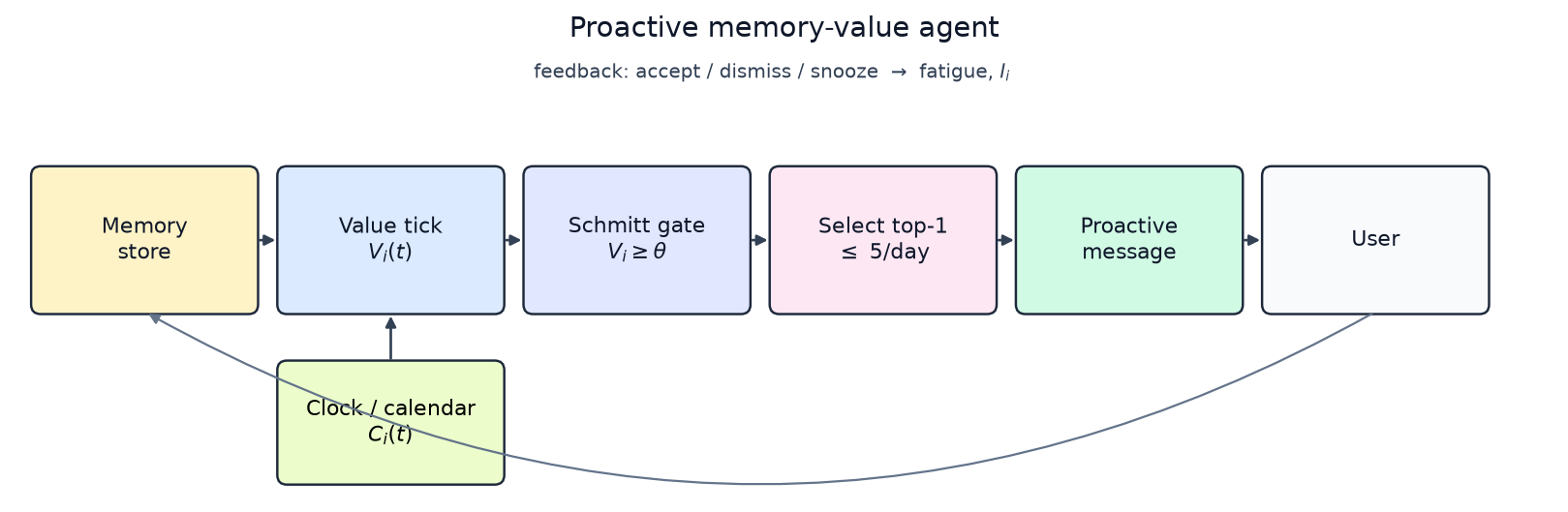
flowchart TD
  MS[Memory Store] --> VT[Value Tick]
  CTX[Context] --> VT
  VT --> TH{armed and V ≥ θ?}
  TH -->|yes| SEL[top-1 + rate limit]
  SEL --> GEN[proactive message]
  GEN --> USER[User]
  USER --> FB[accept / dismiss / snooze]
  FB --> MS
Method (simulation)
Plant eight synthetic memories over a 72-hour user day: commitments with deadlines (blog draft, bill, call mom, standup prep), a soft café intention, a gym plan, plus low-value chatter that should rarely win. An oracle marks time windows where a nudge would have been useful. A scripted user “accepts” only when the emit is useful and lands in preferred hours; otherwise dismisses.
Tick \(\Delta t = 0.25\) h. Ablate oscillation (\(A_i = 0\)) vs full policy. Metrics: precision of emits, oracle-window recall, accept rate, spam/day, quiet-hour violations, time-to-useful.
python -m sim.run_sim
python -m sim.run_sim --no-oscillation
Results
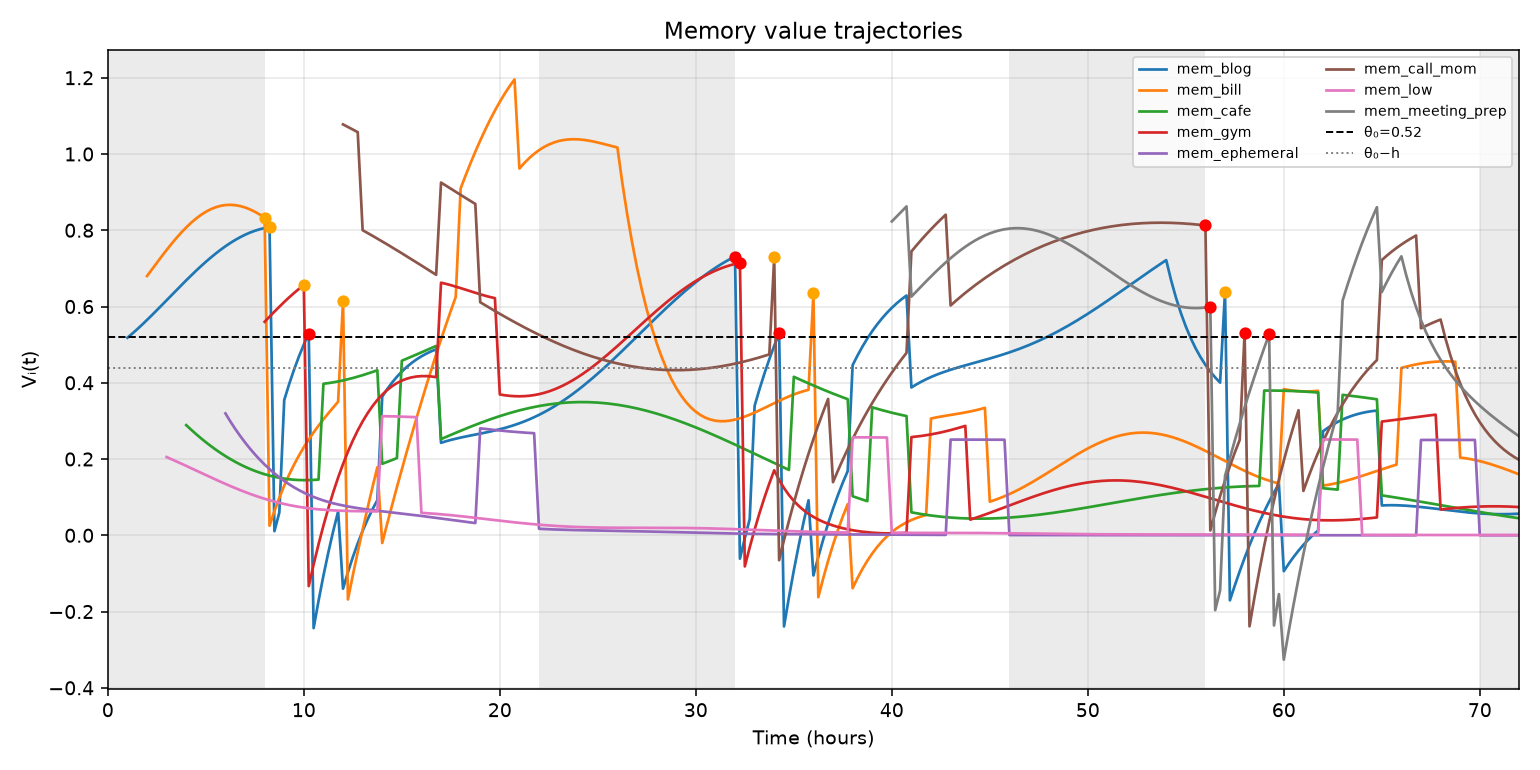
| Policy | Precision | Recall | Accept | Spam/day | Quiet viol. | Mean TTU (h) |
|---|---|---|---|---|---|---|
| Full (osc + fatigue + hysteresis) | 0.53 | 0.50 | 0.27 | 5.0 | 0 | 2.4 |
| No oscillation | 0.40 | 0.40 | 0.13 | 5.0 | 0 | 8.0 |
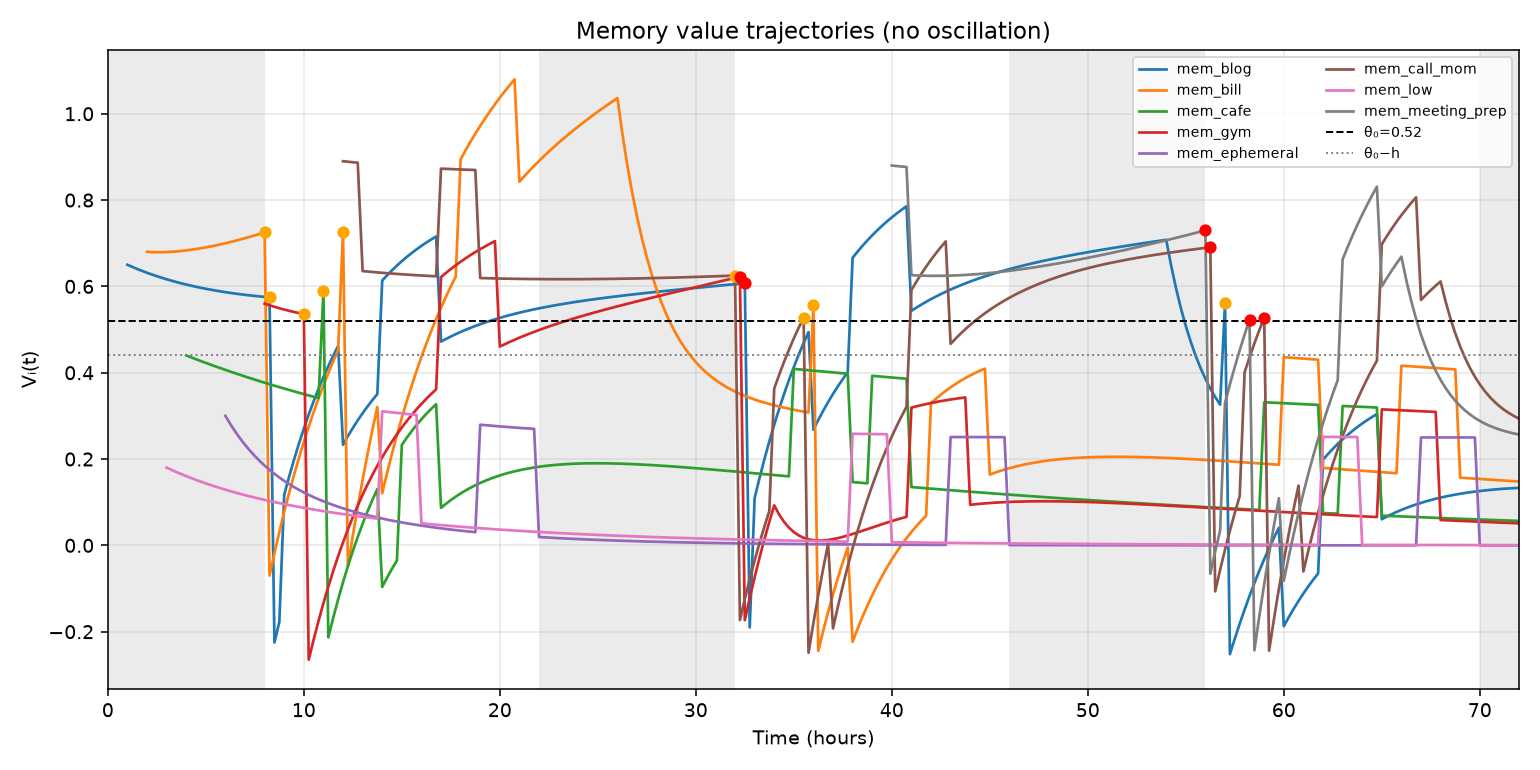
On this synthetic day, oscillation improves precision and accept rate and cuts time-to-useful, at the same spam cap. Grey bands are quiet hours; red/orange dots are emits (useful / not).
What this shows (and does not)
- A clock-driven per-memory value with decay + oscillation + urgency + fatigue is enough to schedule proactive nudges in simulation.
- Schmitt hysteresis + quiet hours can hold quiet-hour violations at zero while still hitting a rate cap.
- Oscillation is not free entertainment: on the planted day it moved precision 0.40 → 0.53 and TTU 8.0 → 2.4 h.
- This does not measure real user utility. Accept/dismiss is scripted. Importance is planted, not LLM-estimated.
- This does not replace query-triggered retrieval (Generative Agents / MemGPT archival search). It answers a different question: when to interrupt the human.
- Daily cap saturation (5/5) means ranking still matters; a better selector or adaptive \(\theta\) is open work.
Related work (short)
Park et al. score memory by recency × importance × relevance and reflect when importance accumulates. MemGPT/Letta treat memory as an OS with interrupts. Recent “proactive memory agent” work injects reminders into another agent. Oblivion uses decay-driven activation. Horvitz / BusyBody / Jogger ground interruption cost and context-sensitive reminding. Howard’s value of information justifies thresholded surfacing. Citations and URLs: repo docs/related-work.md.
Open questions
- Learn \(\omega_i, A_i\) per tag class (commitment vs trivia) from accept/dismiss?
- Re-score \(I_i\) periodically with an LLM, or only at write time?
- Per-channel thresholds (chat vs OS notification vs email)?
- Shared phase across related memories so a “weekend family” cohort rises together?
Reproduce
git clone https://github.com/dylanler/proactive-memory-value
cd proactive-memory-value
python3 -m venv .venv && source .venv/bin/activate
pip install -r requirements.txt
python -m sim.run_sim
Design, experiment plan, and diagrams: docs/. Images on the site live under /images/pmv_*.png.